Bulgaria Workforce Market Overview & Labour Challenges
As of Wednesday, February 4, 2026, 6,688,581 people call Bulgaria home, according to Worldometer’s analysis of the most recent United Nations data.
Low Unemployment & Tight Labour Market: Unemployment remains very low at around 3.4–3.9% in 2025. Indicates a tight labour market, with employers struggling to fill vacancies.
Employment Levels: Around 2.9–3.0 million people are employed. Employment rate is just over 50% of the adult population.
GDP Growth: The economy is growing steadily, with GDP expanding by about 3.1–3.4% year-on-year. Growth is mainly supported by private consumption and investment.
Labour Shortages: Over 30% of firms report labour shortages as a constraint on production. Shortages are most acute in industry and services.
Population & Demographics: Bulgaria faces long-term population decline and ageing. A shrinking working-age population is intensifying labour market pressures.
Rising Labour Costs: Hourly labour costs have increased significantly. Wage growth reflects strong competition among employers for scarce workers.
Consumption-Driven Growth: Household consumption accounts for over 60–70% of GDP. Strong domestic demand continues to support economic growth.
Eurozone Integration: Bulgaria adopted the euro in 2026. Expected benefits include greater monetary stability, lower transaction costs, and increased investment, though challenges remain.
Regional Labour Market Differences: Significant regional disparities exist. Urban areas (especially Sofia) have much stronger labour markets than rural regions.
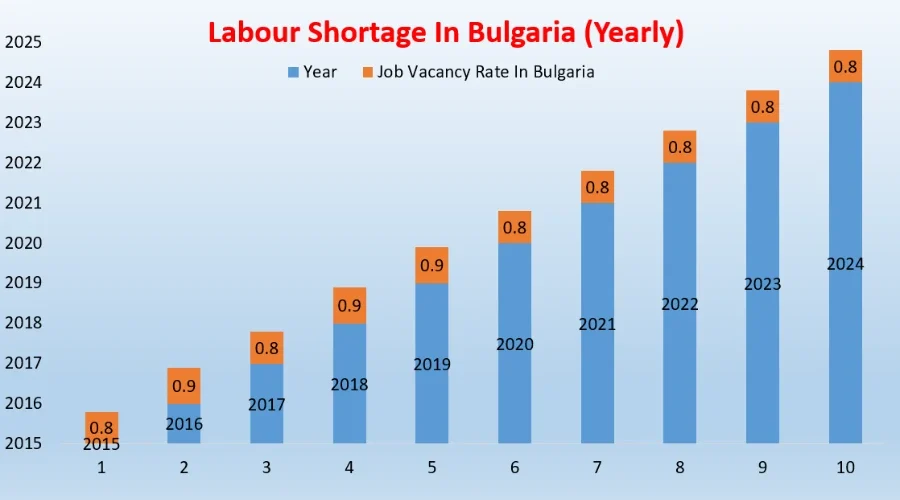
Bulgaria Labour crisis rate (Yearly)
Bulgaria’s labour shortage indicator has stayed consistently high for a decade, moving only between 0.8 and 0.9. Peaks in 2016, 2018, and 2019 (0.9) show periods when employers struggled even more to find workers, especially in industry and services. Even during 2020, when many economies slowed down, shortages remained strong at 0.8, proving the issue is structural rather than temporary. This long-term pressure is linked to population decline, ageing workers, and migration of young Bulgarians abroad & for more detail, refer to the graph
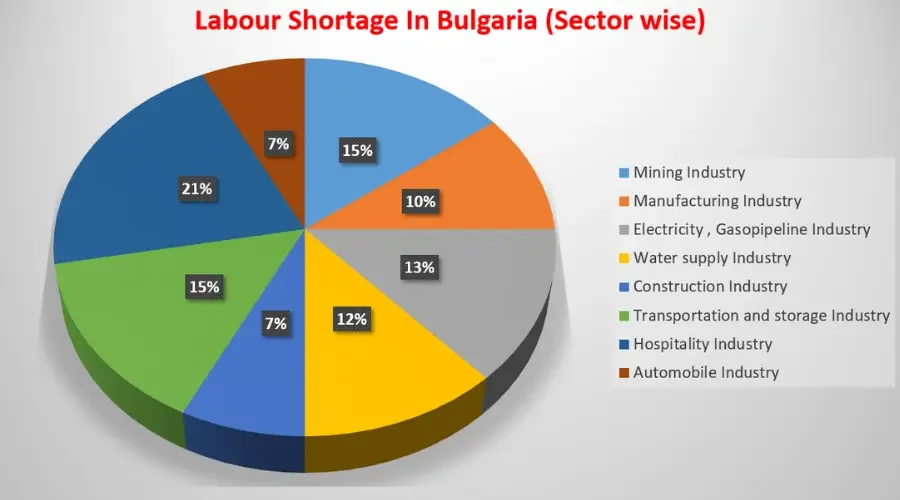
Bulgaria Labour crisis rate (Industry wise)
In 2026, Bulgaria is also seeing rising demand in renewable energy, industrial automation, and logistics technology, where local expertise is limited. These emerging skill gaps make foreign worker recruitment a practical solution. Bulgaria’s sector-wise job vacancy rates highlight growing pressure across key industries in 2026. The hospitality sector leads with 1.4, reflecting tourism expansion and seasonal demand. Mining and transportation & storage (both 1.0) also show steady hiring needs, driven by logistics growth and resource activity refer the graph
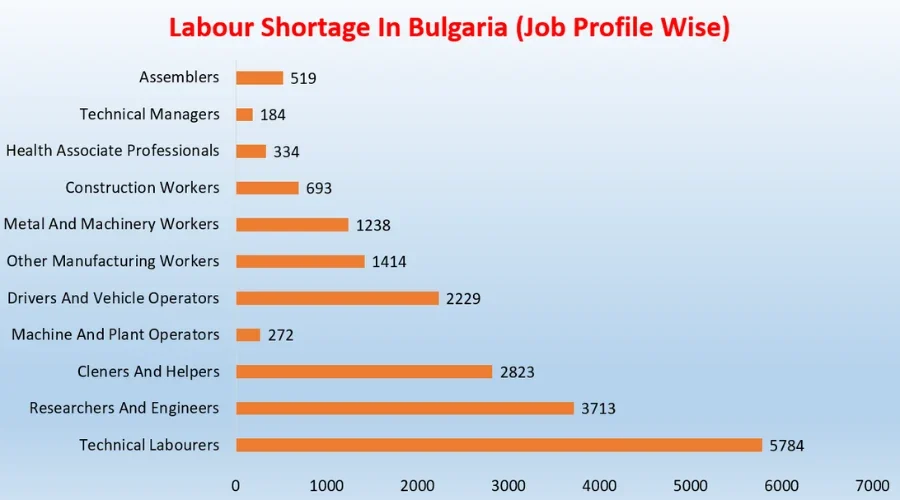
Bulgaria Labour crisis rate (Job profile wise)
Bulgaria is facing serious workforce shortages across both technical and support occupations, showing strong demand for foreign talent. Faced Biggest Gap Around (5,784 vacancies), which includes electricians, mechanics, welders, maintenance technicians, and industrial repair workers — essential for factories, energy systems, and infrastructure projects. Cleaners and Helpers (2,823) highlight shortages in hospitality, healthcare, and facility services. Transport and industry are affected too, with Drivers and Vehicle Operators (2,229) and Other Manufacturing Workers (1,414) needed for supply chains
Employer Pain Points in Bulgaria Labour Market
Complex Work Permit Procedures: Employers struggle with multi-step approval processes, unclear documentation requirements, and long waiting periods from different government departments.
Changing Immigration Rules: Frequent updates to labour and migration policies make it hard for companies to stay compliant, increasing the risk of delays or rejections.
Long Processing Times: Work permits and visas can take several months, causing project delays and production slowdowns.
Skill Verification Difficulties: Employers find it hard to verify whether foreign candidates truly have the technical skills and certifications required.
Language & Communication Barriers: Many foreign workers do not speak Bulgarian, leading to workplace communication and safety issues.
Involvement of the More Cost in Recruitment Process
How BCM Group Helps Your Business
BCM Group handles the complete foreign hiring process — from candidate sourcing to final onboarding.
Specialized Legal Responsibility: BCM Group works with a specialised immigration and labour lawyer who takes full responsibility for legal compliance. All permits, contracts, and filings are prepared correctly, reducing risks of rejection, fines, or legal disputes for employers.
Simplified Work Permit Procedures: Complex and multi-step approval processes are streamlined by BCM Group. Documentation requirements are clearly defined, properly prepared, and submitted in the correct order to avoid unnecessary delays.
Faster Processing & Reduced Delays: With deep knowledge of Bulgarian immigration procedures, BCM Group minimizes waiting times by preventing errors, missing documents, and reapplications that commonly slow down approvals.
Compliance with Changing Immigration Rules: BCM Group continuously monitors changes in labour and migration regulations. Employers stay fully compliant without having to track policy updates themselves.
Industries We Serve Globally
We provides skilled workers across the following industries:
Construction Industry
Manufacturing Industry
Automobile Industry
Logistics & Warehousing
Hospitality Industry
Refining Industry
Agriculture Industry
Utilities & Infrastructure
Plastic Industry
Skilled Profiles We Provide
We provide employers with the following skilled profiles:
Welders (MIG, TIG, ARC Certified)
Electricians (Industrial & Maintenance Licensed)
CNC Operators & Machine Operators
Fitters & Mechanical Technicians
Construction Workers
Drivers (Heavy Truck Driver)
Warehouse Workers (Packaging workers)
Food Production Workers (Chefs, Waiters)
Available Employment models
Flexible employment models designed for Bulgarian employers.
Overseas Recruitment (India → Bulgaria)
Employee Leasing / Employer of Record (EOR)
Talent Aquisition
Payroll-Based Workforce Deployment
Bulk & Project Workforce Hiring
Contract & Temporary Staffing
Each model ensures legal compliance, workforce flexibility, and operational efficiency.
Partner with bcm group
Facing labour shortages or expansion challenges in Bulgaria? BCM Group delivers reliable, compliant, and scalable Indian manpower solutions that support uninterrupted operations and long-term growth.