Croatia Workforce Market Overview & Labour Challenges
Croatia’s labour market is tightening as the population declines rapidly in 2025 the population is 3,848160 and in 2026 3822345 the rate was decrease — a core structural challenge behind the labour crisis. Over recent years, Croatia’s total population has been falling due to low birth rates, ageing and high emigration of young workers, and this trend continues into 2026. These demographic shifts are a major driver of labour shortages across sectors.
According to OECD analysis, the working-age population is shrinking faster than the total population, contributing to a smaller base of local workers available for employment and leaving sectors struggling to fill vacancies.
After years of growth in foreign employment:
The number of foreign work permits issued has declined in 2025 and into 2026 compared with earlier surges. Stricter permit rules and tighter oversight have slowed new entries, even as labour demand remains high.
Regulatory changes emphasize fair wages and compliance, but also make it harder for some companies to hire abroad.
These shifts reflect a complex balance: Croatia needs foreign labour to fill roles locally, but policymakers are tightening rules to address abuses and integrate workers more sustainably.
As of the latest government statistics, there are approximately 82,000–88,000 registered unemployed persons, while employers report over 240,000 job vacancies annually across sectors. This creates an effective labour gap of more than 150,000 workers, even before accounting for skill mismatches.
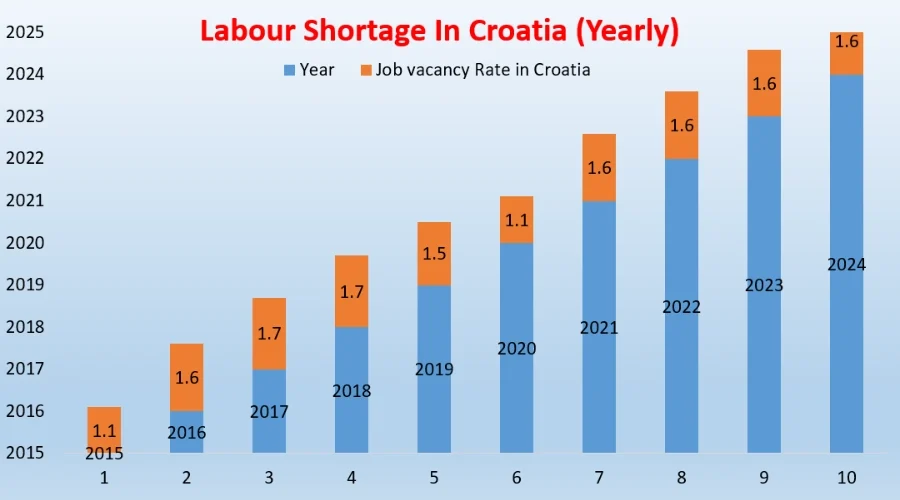
Croatia Labour crisis rate (Yearly)
The job vacancy rate shows the share of total jobs in the economy that remain unfilled — a key indicator of labour market tightness and demand for workers. 2015 – 2018: Rising Demand for Workers: In 2015, the job vacancy rate was 1.1%, indicating relatively few unfilled positions, From 2016 to 2018, the rate rose to 1.6 – 1.7%, This period shows that demand for labour was increasing, with employers struggling more to find suitable workers — a sign of a strengthening labour market. 2019 – 2020: Slight Dip: The vacancy rate dipped to 1.5% in 2019 and further to 1.1% in 2020.
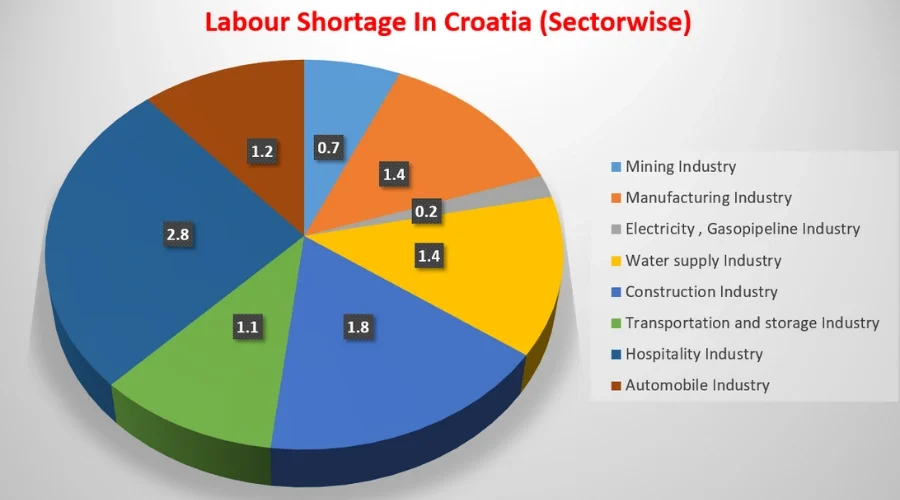
Croatia Labour crisis rate (Industry wise)
Croatia’s labour market shows clear differences in worker demand across industries, reflected in varying job vacancy rates. The hospitality industry faces the most intense pressure, with a 2.8% vacancy rate, highlighting strong demand driven by tourism and seasonal services. Construction follows at 1.8%, showing ongoing infrastructure and development activity but a shortage of skilled labor. Mid-range vacancy levels appear in manufacturing (1.4%) and water supply (1.4%), indicating steady operational demand.
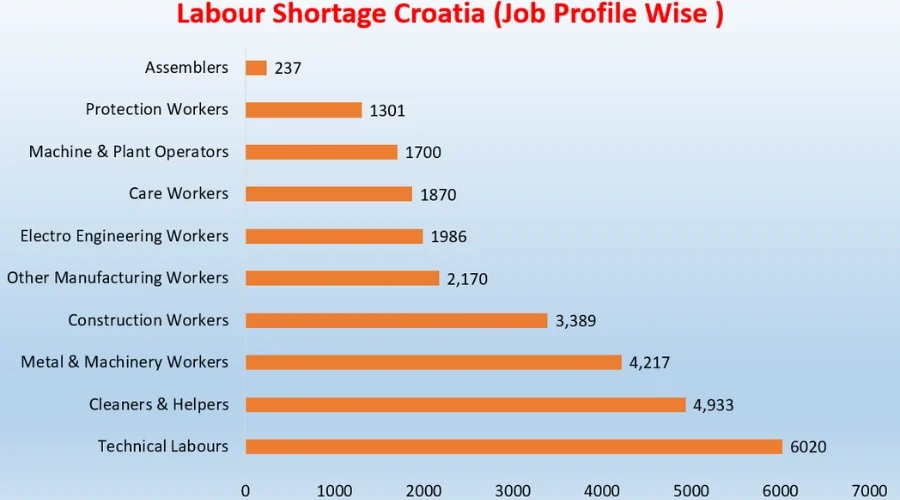
Croatia Labour crisis rate (Job profile wise)
Croatia’s labour market is facing a clear skills shortage, with demand heavily concentrated in technical and manual occupations. The highest number of vacancies is for technical labourers (6,020), followed by cleaners and helpers (4,933) and metal and machinery workers (4,217). Strong demand also exists for construction workers (3,389) and manufacturing-related roles, reflecting Croatia’s growing infrastructure, industrial production, and tourism-driven economy. A major gap is visible in electro-engineering workers (1,986) and plant operators (1,700)
Employer Pain Points in Croatia Labour Market
Demographic Decline and Shrinking Workforce: Croatia’s population has been falling rapidly (about 8 % decline over the last decade), and the working‑age population is decreasing even faster.
Skill Mismatches and Training Gaps: Employers struggle with misalignment between the skills needed and those available in the labour pool.
Lack of Suitable Workers Across Sectors: A majority of Croatian employers — especially in construction, manufacturing and services — report difficulty finding workers with the right skills and experience.
Heavy Reliance on Foreign Workers — and Regulatory Challenges: Although Croatia employs a growing number of foreign workers, new work permit regulations have made it more complex and costly to hire international labour.
Seasonal and Sectoral Supply Constraints: Key industries such as tourism, hospitality and healthcare face seasonal workforce shortages that domestic labour alone cannot meet, especially during peak periods.
How BCM Group Helps Your Business
Workforce Needs Assessment: BCM Group begins by analysing the employer’s operational requirements, including job roles, skill levels, headcount, shift patterns, and project timelines.
International Recruitment from Labour-Surplus Markets: Rather than competing in an increasingly limited local labour pool, BCM Group sources workers from non-EU countries with established availability of skilled and semi-skilled labour.
Candidate Screening and Skill Verification: All candidates undergo structured screening, including: Verification of relevant work experience, Trade and skill assessment where applicable, Evaluation of work discipline and reliability.
Work Permit and Immigration Management: BCM Group manages the complete legal and administrative process, including: Work permit applications, Visa processing, Employment documentation, and many other processes.
Coordinated Deployment and Onboarding: Once approvals are obtained, BCM Group coordinates worker arrival, contract activation, and onboarding in line with the employer’s operational schedule.
Industries We Serve Globally
We provides skilled workers across the following industries:
Construction Industry
Manufacturing Industry
Automobile Industry
Logistics & Warehousing
Hospitality Industry
Refining Industry
Agriculture Industry
Utilities & Infrastructure
Plastic Industry
Skilled Profiles We Provide
We provide employers with the following skilled profiles:
Welders (MIG, TIG, ARC Certified)
Electricians (Industrial & Maintenance Licensed)
CNC Operators & Machine Operators
Fitters & Mechanical Technicians
Construction Workers
Drivers (Heavy Truck Driver)
Warehouse Workers (Packaging workers)
Food Production Workers (Chefs, Waiters)
Available Employment models
Flexible employment models designed for croatian employers.
Overseas Recruitment (India → Croatia)
Employee Leasing / Employer of Record (EOR)
Talent Aquisition
Payroll-Based Workforce Deployment
Bulk & Project Workforce Hiring
Contract & Temporary Staffing
Each model ensures legal compliance, workforce flexibility, and operational efficiency.
Partner with bcm group
Facing labour shortages or expansion challenges in Croatia? BCM Group delivers reliable, compliant, and scalable Indian manpower solutions that support uninterrupted operations and long-term growth.