
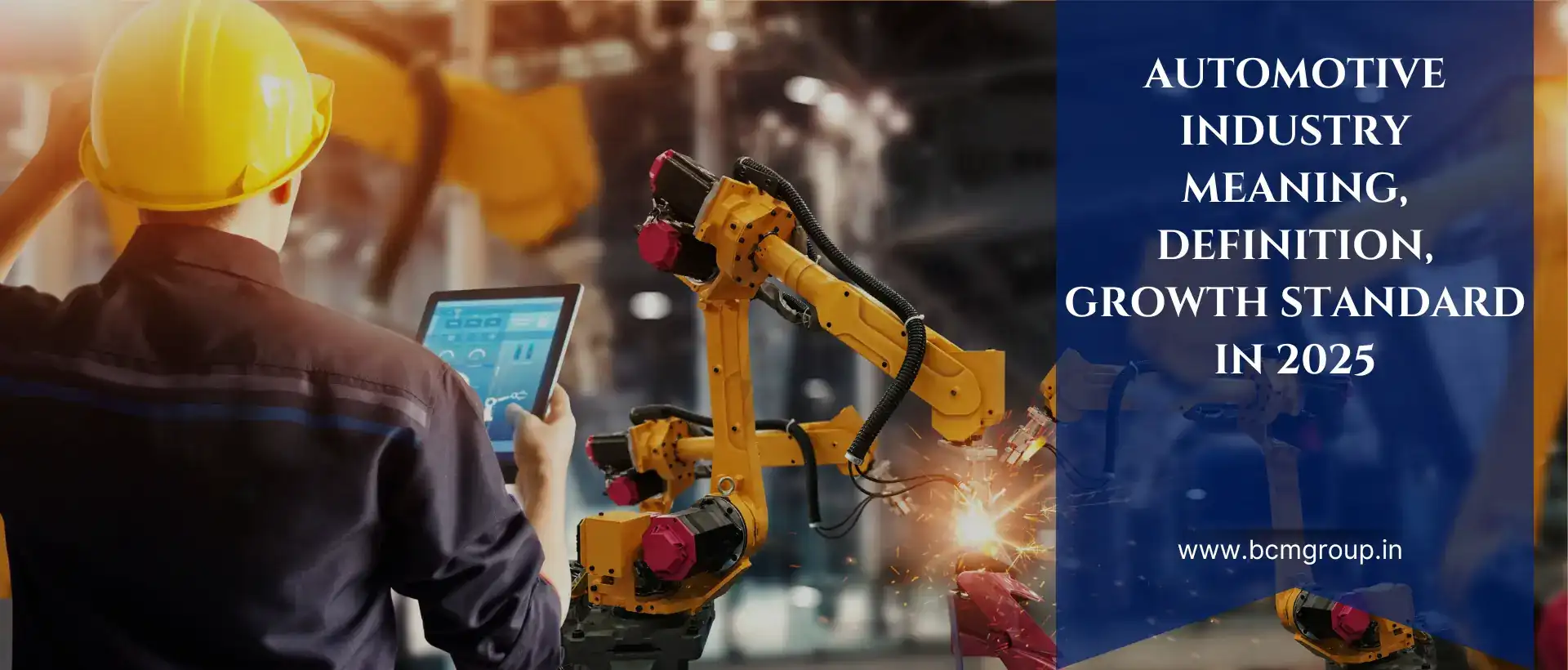
The automotive industry meaning is the broad array of companies involved in designing, developing, producing, and selling cars. The automotive industry and automobile industry are generally same but some minor changes with respect to the jobs role like in the automotive industry, include cars, trucks, buses, and all their parts and services. some of not aware about the these industries make a significant contribution in the growth economics but have a major contribution to world economic development through employment, support for exports, and advancing technology.
As per the government survey from 2024-2025, the automotive industry is transforming with technological developments in electric cars, automation, and sustainability. clearally the definition of the automotive industry is important to realise its impact on transport, trade, and the environment. so that in its growth, it remains a key driver of modern mobility and industrial growth and ultimately increases the job opportunities, especially for candidates with technically educated backgrounds. Worldwide the growth in these sectors is increasing day by day; that’s the reason the BCM Group helps workers for getting job opportunities so they can build their careers in Abroad.
The automotive industry Definition by India’s Ministry of Heavy Industries clearly stop the confusion in many indian as manufacturing all kinds of motor vehicles, ranging from two‑wheelers, three‑wheelers, to passenger cars, light and heavy commercial vehicles (trucks, buses), and tractors. It is one of the driving forces of the Indian economy, contributing approximately 6% to India’s GDP and 35% to manufacturing GDP. The auto component industry is also a part of this industry, making engine parts, drive transmissions, steering components, chassis, braking systems, electrical systems, and others for OEMs and aftermarket segments
A precise Automotive Industry description entails comprehending the whole environment that goes into supporting and producing vehicles. This involves everything from the initial vehicle design and engineering to making, fitting parts together, distributing finished products, and taking care of sales and after-sales services. Many people are confused about the Automotive industry only working with the automobile and commercial vehicles, but it is not true. Nowadays, India is a Developing country so which drives innovation in electric vehicles, autonomous technologies, and connected mobility solutions. With its far-reaching effects on employment, trade, and infrastructure, the automobile industry continues to be a major pillar of contemporary economies and industrialisation across the globe.
Automobile industry growth has made tremendous progress both internationally and domestically. The Automotive Industry works internationally, so that vehicle production recovered to almost 93.5 million units in 2023, headed by China, the United States, and Germany (OICA). The main motive of implementation of the green revolution in regions of India, increasing from 5 million units in 1995 to 1998 to more than 28 million in 2023–24 . Electric vehicles (EVs) are driving this growth, with China and Europe leading EV manufacturing, while that of India’s EV sales increased 49% in 2022. This ongoing global and regional growth indicates day-by-day achievements in innovation, manufacturing, and consumer demand.
Automotive Industry Meaning And the scope with the fastest rates of growth in the world which is also generating thousands of jobs for trained and semi-skilled people.
Growing Demand Worldwide: Global automotive manufacturing is growing in response to the growing demand for automobiles, electric vehicles, and transportation solutions.
European Industry Boom: By making significant investments in the automobile industry, nations like Germany, Hungary, Romania, and Poland are creating opportunities for foreign labor.
Demand for Qualified Personnel: Welders, painters, technicians, assembly line workers, and quality control specialists are in greater demand overseas.
Technology Integration: Indian ITI and certificate holders are extremely valuable since modern cars require individuals with training in electronics, automation, and diagnostics.
Europe is experiencing a labor deficit, and several European nations are embracing Indian talent by granting them legal work visas.
With the industry's move towards green tech, companies are looking for professionals with expertise in EV systems and sustainable practices.
Shortages of chips have retarded production, decreasing near-term hiring while raising demand for electronics-skilled specialists in technology.
The transition towards electric vehicles and intelligent mobility increases competition for R&D, battery technology, and AI integration roles.
Work now calls for flexibility, online capabilities, and customer focus as a result of evolving market demands.
Supply chain problems call for logistics professionals, but competition is high for strategic and international opportunities.
Businesses prefer candidates who are multi-capable and industry certified due to increased manufacturing sophistication. These are the top automotive industry challenges.
BCM Group See the future of the automotive sector is changing at a fast pace, because it is a more climate-friendly made by technicians with highly sharp minds behind it by technological innovation, sustainable objectives, and shifting global policies. This change is not only changing cars but is also bringing tremendous job opportunities, particularly for ITI-certified experts, diploma engineers, and skilled technicians in India and the international market.
The worldwide transition towards electric vehicles (EVs) is fueling the need for new skill sets in EV assembly, battery production, and maintenance. Electric vehicle factories need electrical, mechanical, and mechatronics technicians, and hence it is a high recruiter for vocational and technical personnel. India’s EV push via initiatives such as FAME II and PLI (Production Linked Incentive) is increasing localized production and demand for skilled workers.
Self-driving and semi-autonomous cars require professionals with expertise in sensor calibration, diagnostics, and electronics. ITI and diploma graduates with training in automotive electronics, robotics, and embedded systems are among the most sought after in the changing environment. Practical, hands-on skills are needed to maintain such sophisticated systems — a core area of strength for vocational graduates and technicians.
Growth of connected cars and intelligent mobility platforms necessitates digital interfaces and IoT device installation, repair, and troubleshooting. This creates opportunities for automotive service technicians, telematics installers, and IT-mechanical integration experts, both in metropolitan and rural areas.
With tougher emissions and safety regulations, car manufacturers need employees to assist in redesigning and fitting vehicles to adhere to new regulations. Green manufacturing methods, such as waste minimization and energy-saving assembly lines, require technicians with expertise in state-of-the-art industrial systems.
India is emerging as a global manufacturing center, particularly for EVs and auto parts. This is opening up mass employment opportunities in Tier 2 and Tier 3 cities. Internationally, the lack of skilled auto workers is compelling businesses to employ from overseas, and doors are opening for Indian diploma and ITI-certified engineers to migrate to foreign countries. Germany, Canada, and the UAE are recruiting skilled automotive professionals because industry-wide shortage of labor has created an opportunity to seek the talent. For these reason the Future of automotive industry increases in internationally.
In today’s growing world, the people more reasearched on adoption of more innovation in day to day life . so that Artificial intelligence in the automotive sector is plays role in the assembly line and machine learning transforming the design of vehicles, intelligent mobility, and manufacturing operations. Artificial Industry and Automotive industry meaning is different part. Artificial intelligence in Automotive Industry driving and predictive maintenance to real-time driver assistance, AI occupies center stage in current automotive innovation. In manufacturing facilities, AI-powered automation and robotics streamline production, minimize errors, and maximise quality. This transformation is generating tremendous demand for machine learning managers and AI technicians to create, install, and service these smart systems. With smart factories being the standard, professionals who have expertise in AI, machine learning, and industrial automation are imperative, thus making AI a driving factor in transforming the workforce and future of the automotive industry.
As the future of the automotive industry meaning unfolds, it is not just about smarter vehicles but also about creating a skilled, job-ready workforce. For ITI students, diploma engineers, and technical professionals, this is a golden opportunity to align with industry trends and become key drivers of the automotive revolution. We conclude that AI plays an important role in increasing the demand in the automotive industry internationally. that’s the reason the employment opportunities for highly skilled workers, especially engineering candidates, diploma candidates, and ITI trade workers, have high demand in automotive industries.
[contact-form-7 id=”d2f63f9″ title=”Candidate Form”]
[contact-form-7 id=”3b2dcad” title=”Employer Form”]
License Number: MUMBAI/PARTNERSHIP/5493853/2021
Address: 409, 4th Floor, Amanora Chambers, Amanora Mall, Near Magarpatta City, Hadapsar, Pune – 411208
© 2024–2025 bcmgroup. All rights reserved.
Privacy Policy | About Us | Contact Us | Submit Your CV | Submit Your Requirements
