Romania Workforce Market Overview & Labour Challenges
As of 1 January 2026, about 18.8 million people lived in Romania. The GDP rate of Romania in 2025 is about $422.51 billion , where Growth rate is 1 % in 2025. As per projection, the growth rate in 2026 will be increase upto 1.4% , where per capita GDP is $22,436.
Romania is currently facing a significant labour shortage that is impacting multiple sectors of its economy. Recent reports estimate that Romania has a deficit of over 600,000 workers, prompting employers to recruit from abroad to fill essential roles in construction, manufacturing, hospitality, and logistics.
To respond to this shortage, the Romanian Government has set a quota of 90,000 newly admitted non-EU foreign workers for the year 2026, aimed at partially covering personnel deficits in key sectors.
Structural challenges contribute to this scarcity. Romania’s employment rate was about 63 % in 2023, below the OECD average of 70 %, partly due to an ageing population and large numbers of working-age citizens emigrating to other EU countries.
The country’s workforce participation also lags the broader European Union, with only approximately 66 % of people aged 15–64 active in the labour market, compared with around 74 % in the EU.
To partly address this shortage, Romanian authorities issued over 140,000 work permits to non-EU nationals by the end of 2024, primarily for jobs in sectors where domestic labour is scarce, such as agriculture, construction, cleaning, and logistics.
These data from Eurostat, OECD, and Romanian labour market reports show that Romania’s labour scarcity is real, documented, and increasingly influencing recruitment strategies — including the search for international workers
Romania Labour crisis rate (Yearly)
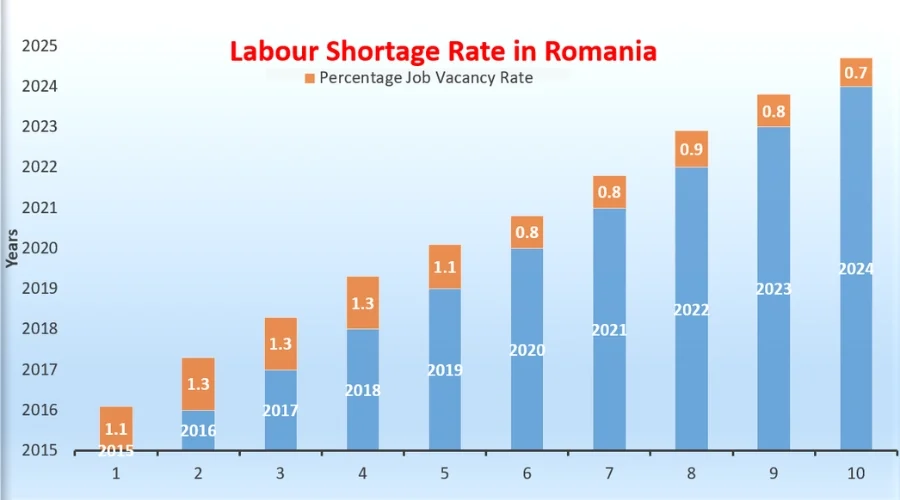
Romania’s job vacancy rate data from 2015 to 2024 shows an important story about the country’s evolving labour market. Romania’s job vacancy rate rose from 1.1% (2015) to 1.3% (2016–2018), showing growing labour demand. The rate fell after 2019, reaching 0.7% in 2024, but shortages still persist. From 2021 onward, Romania entered a phase of structural labour deficit. Even with a lower official vacancy rate, employers across key industries continue to struggle to fill positions. Employers increasingly rely on foreign workers to fill essential roles.
Romania Labour crisis rate (Industry wise)
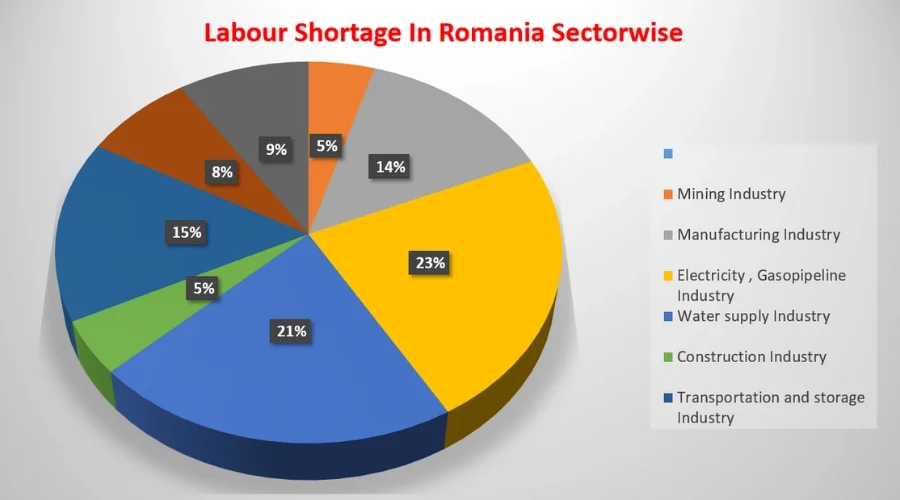
Romania faces labour shortages across key industries, according to recent Eurostat-based data. The electricity and gas sector shows the highest shortage at 23%, followed by water supply at 21%, reflecting a critical need for infrastructure technicians. Transportation and storage report a 15% gap, while manufacturing faces a 14% shortage, affecting production capacity. The automobile industry has a 9% deficit, and hospitality struggles with an 8% shortage, especially in service roles. These shortages highlight Romania’s growing dependence on foreign workforce hiring.
Romania Labour crisis rate (Job profile wise)
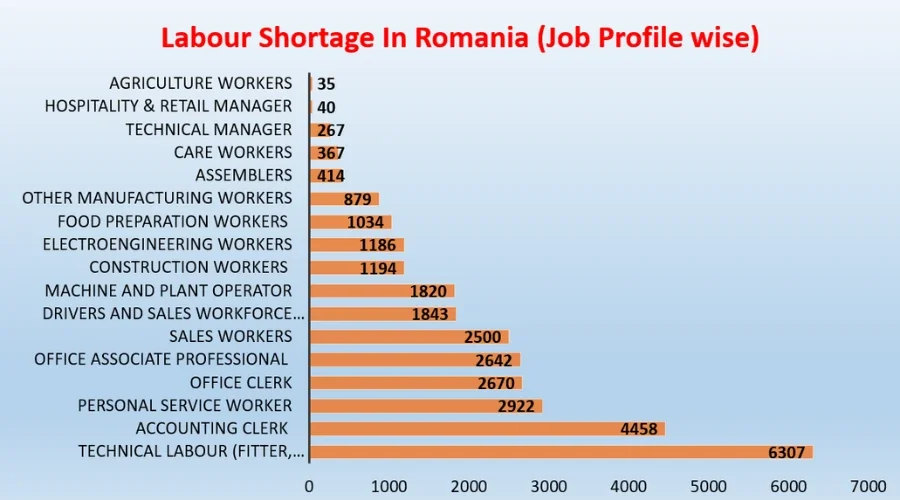
As per researched and analysed data from Eurostat, Romania faces major job vacancies across multiple occupations: Technical labour 6307, Accounting clerks 4458, Personal service workers 2922, Office clerks 2670, Office associate professionals 2642, Sales workers 2500, Drivers 1843, Machine operators 1820, Construction workers 1194, Electroengineering workers 1186, Food preparation 1034, Manufacturing workers 879, Assemblers 414, Care workers 367, These figures highlight widespread workforce shortages across both skilled and support roles.
Employer Pain Points in Romania’s Labour Market
Unfilled Positions for Months: Many companies keep vacancies open for 3–6 months without finding suitable candidates,
Project Delays and Production Loss: Construction sites slow down, factory output drops, and delivery timelines extend because there are simply not enough workers to run full operations.
Overtime Burnout of Existing Staff: Current employees are forced to work overtime to compensate, leading to fatigue.
Workers Leaving for Higher EU Salaries: Even after hiring locally, employers lose staff quickly as workers move to Germany, Italy for better pay.
Poor Candidate Quality: Available applicants often lack practical experience, certifications, or discipline required for industrial roles
Wage Pressure Without Productivity Gain: To attract workers, employers raise wages — but productivity does not increase at the same pace, reducing profit margins.
How BCM Group Helps Your Business
Workforce Needs Assessment: BCM Group begins by analysing the employer’s operational requirements, including job roles, skill levels, headcount, shift patterns, and project timelines.
International Recruitment from Labour-Surplus Markets: Rather than competing in an increasingly limited local labour pool, BCM Group sources workers from non-EU countries with established availability of skilled and semi-skilled labour.
Candidate Screening and Skill Verification: All candidates undergo structured screening, including: Verification of relevant work experience, Trade and skill assessment where applicable, Evaluation of work discipline and reliability.
Work Permit and Immigration Management: BCM Group manages the complete legal and administrative process, including: Work permit applications, Visa processing, Employment documentation & many others.
Coordinated Deployment and Onboarding: Once approvals are obtained, BCM Group coordinates worker arrival, contract activation, and onboarding in line with the employer’s operational schedule.
Industries We Serve Globally
We provides skilled workers across the following industries:
Construction Industry
Manufacturing Industry
Automobile Industry
Logistics & Warehousing
Hospitality Industry
Refining Industry
Agriculture Industry
Utilities & Infrastructure
Plastic Industry
Skilled Profiles We Provide
We provide employers with the following skilled profiles:
Welders (MIG, TIG, ARC Certified)
Electricians (Industrial & Maintenance Licensed)
CNC Operators & Machine Operators
Fitters & Mechanical Technicians
Construction Workers
Drivers (Heavy Truck Driver)
Warehouse Workers (Packaging workers)
Food Production Workers (Chefs, Waiters)
Available Employment models
Flexible employment models designed for Romanian employers.
Overseas Recruitment (India → Romania)
Employee Leasing / Employer of Record (EOR)
Talent Aquisition
Payroll-Based Workforce Deployment
Bulk & Project Workforce Hiring
Contract & Temporary Staffing
Each model ensures legal compliance, workforce flexibility, and operational efficiency.
Partner with bcm group
Facing labour shortages or expansion challenges in Romania? BCM Group delivers reliable, compliant, and scalable Indian manpower solutions that support uninterrupted operations and long-term growth.